
How AI Paper Grading is Transforming Indian Coaching Institutes and Schools (2026)
With classroom sizes ballooning and administrative duties multiplying, manual evaluation of descriptive mock tests and board papers has become a massive bottleneck. Here is how logic-aware AI paper grading is stepping in to change the game.
India's education sector is characterized by massive scale and intense competition. In prep hubs like Kota, Hyderabad, and Delhi, coaching institutes routinely evaluate thousands of descriptive mock test sheets for examinations like the Joint Entrance Examination (JEE) and the National Eligibility cum Entrance Test (NEET). At the same time, K-12 schools throughout the country are navigating the structural changes mandated by the National Education Policy (NEP) 2020.
The core challenge? Subjective evaluation. While Multiple Choice Questions (MCQs) can be instantly graded via OMR sheets, evaluating step-by-step math derivations, physics solutions, and chemistry mechanisms requires deep human effort. With teachers spending upwards of 200 hours annually grading papers, the feedback students receive is often delayed—and sometimes lacks depth.
The Administrative Bottleneck in Indian Classrooms
Consider the logistics: A standard K-12 school or coaching center preparing batches of 800+ students conducts regular tests every alternate week. That results in thousands of answer scripts. In a manual workflow, teachers are forced to review each script line-by-line, allocate step-wise marks, write correction notes, and total up the scores.
This manual process takes 8 to 12 minutes per descriptive sheet, resulting in grading cycles that stretch across 2-3 weeks. In a fast-paced academic environment, getting back a paper three weeks late means the feedback loses its immediate utility. Students need to understand what step they got wrong today, not next month.
Furthermore, teachers frequently experience grading fatigue. After evaluating 30 or 40 handwritten answer booklets, cognitive load increases, resulting in grading inconsistencies. For instance, a teacher might grade more severely at the end of a long stack of papers than at the beginning. This variance compromises the reliability of critical mock exams, directly impacting student performance analysis.
NEP 2020: Shift from Rote MCQs to Descriptive Assessments
The National Education Policy (NEP) 2020 mandates a structural shift from rote memorization toward concept-based learning. In practice, this means board patterns and terminal examinations are incorporating more subjective, descriptive questions rather than relying solely on easily evaluable Multiple Choice Questions (MCQs).
While this shift is pedagogically sound, it increases the administrative burden on schools. Rather than relying on simple OMR scanners, schools must now find ways to grade thousands of handwritten paragraphs, logic diagrams, and equations. This change has made logic-aware AI grading software a necessary infrastructure piece for modern schools.
How AI Handwriting OCR Bridges the Gap
For decades, standard Optical Character Recognition (OCR) systems struggled with student handwriting, which is often hurried, full of strikethroughs, and annotated in margins. Furthermore, many students in India write in mixed-language scripts or switch between English and regional languages.
GradeSense has addressed this using advanced deep-learning models trained on thousands of handwritten answer sheets. The OCR engine reads cursive writing, crosses out scribbled-out lines, and processes mathematical equations and symbolic notations with over 95% accuracy. By scanning the answer booklets via a phone camera or standard office scanner, schools can digitize and digitize descriptive answers for immediate analysis.
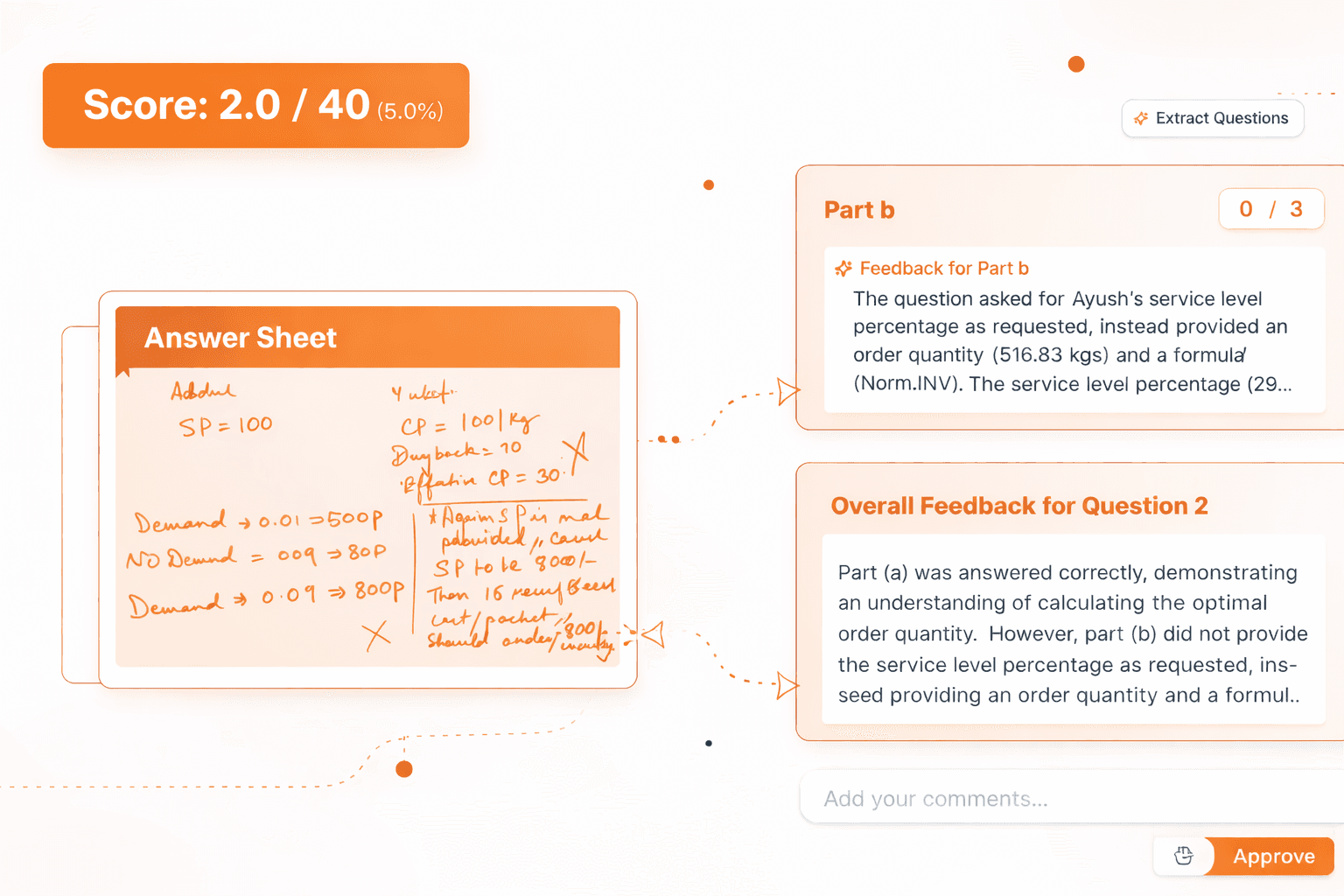
Figure 1: GradeSense deep-learning OCR transcribing cursive student handwriting with 95%+ accuracy.
The underlying transcription technology does not merely read characters; it maps the structural context. It understands the difference between a student crossing out an incorrect step and their final solution. It handles layout structures, such as calculations written in right-hand margins, ensuring that no student is penalized for non-standard layout formatting.
Custom Rubrics & Logic-Aware Step Marking
One of the key requirements of Indian exam formats like CBSE, ICSE, or competitive prep mock tests is step-wise marking. If a student solves a 5-mark mathematics equation correctly up to step four but makes a minor calculation mistake in step five, they must be awarded partial credit.
Unlike generic AI engines that grade based on a broad summary, GradeSense employs a specialized **Rubric Engine**. Teachers define the exact marking scheme, including:
- Specific step milestones and expected formulas.
- Partial credit points allocated for intermediate values.
- Rules for negative marking, if applicable.
- Common mistakes and their corresponding deduction rubrics.
The AI grading infrastructure then parses each script against this logic. If a student uses an alternative but mathematically valid method, the AI detects the logical equivalence and scores accordingly.
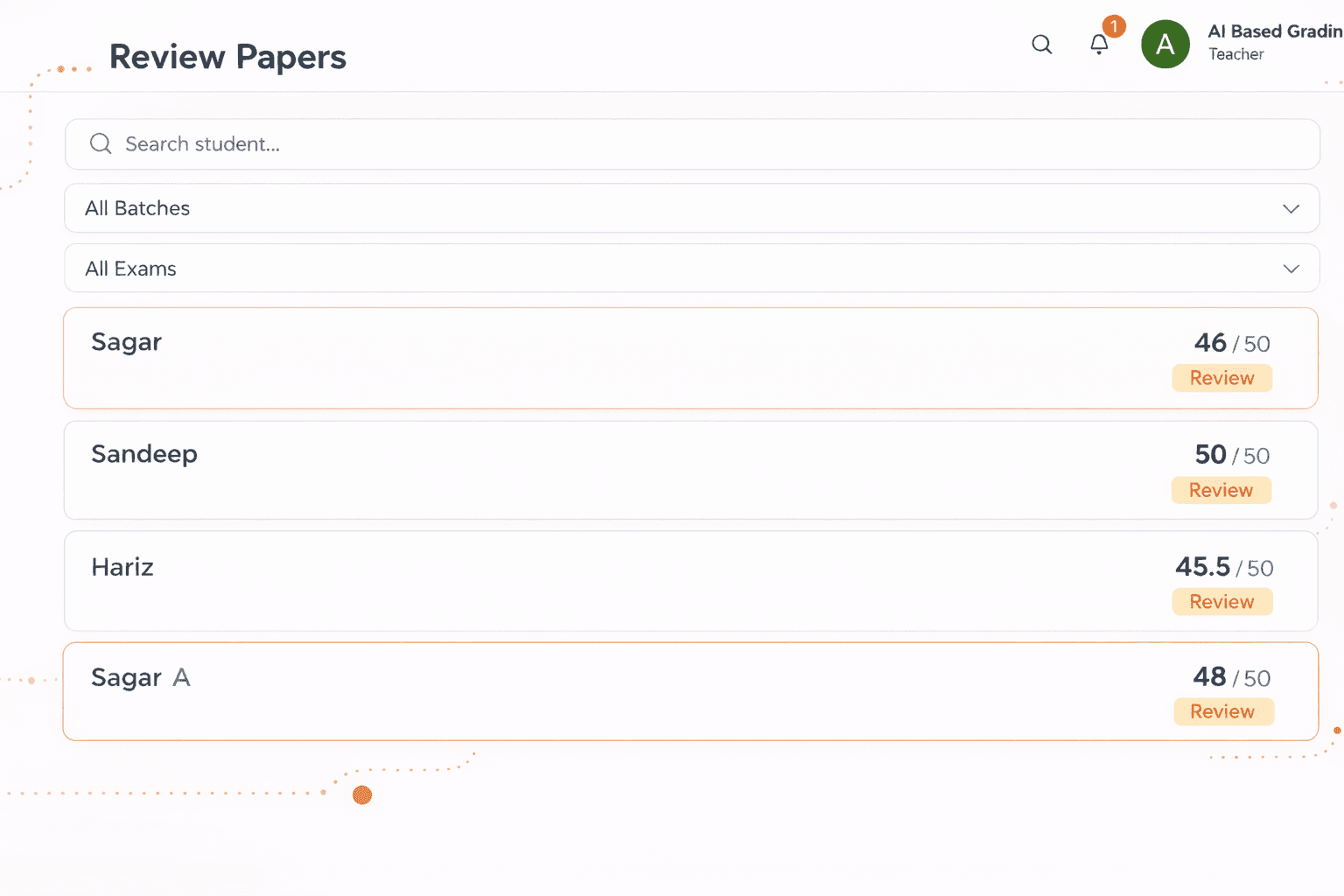
Figure 2: The teacher review dashboard showing logical steps evaluated by AI and side-by-side override inputs.
For example, in a physics derivation, a student might use a different coordinate frame or set of variable names. GradeSense's semantic engine checks the mathematical validity of the derivation sequence, recognizing that a different variable assignment is logically equivalent to the rubric's standard template. This level of logical accuracy prevents incorrect deductions.
Empowering Teachers, Not Replacing Them
A critical concern when adopting edtech tools is the loss of teacher control. At GradeSense, we design with a **human-in-the-loop** philosophy. The AI does the initial heavy lifting: it reads the script, matches it against the rubric, proposes step-by-step marks, and drafts structured feedback notes.
However, the teacher remains the final authority. Through our intuitive grading dashboard, teachers review the AI's grading recommendations, click to override a mark if they disagree, and write custom remarks. The platform saves over 80% of evaluation time, allowing teachers to focus their energy on mentoring students and addressing conceptual gaps revealed by GradeSense's detailed cohort analytics.
This approach keeps the teacher at the center of the learning process. The system acts as a grading assistant that handles the tedious tasks—reading messy handwriting, counting marks, and writing repetitive explanations—while letting the teacher apply their professional judgment to unique cases or border-line marks.
Enterprise Data Compliance and Security Standards
Educational data is highly sensitive, and Indian institutions must maintain compliance with standard data protection regulations. GradeSense takes security seriously:
- Local Data Residency: All student papers, grades, and metadata are hosted on secure, ISO-certified data centers located inside India.
- Encryption Protocols: Data is encrypted at rest using AES-256 and in transit using TLS 1.3, preventing unauthorized access.
- SOC-2 Alignment: Our software architecture aligns with SOC-2 standards, enforcing strict access controls and regular security logs.
- Zero Third-Party Sharing: We do not share student scripts or grading data with public LLM providers or third parties for general model training. Your data is yours alone.
The Future: Cohort Learning Gap Remediation
When exams are graded manually, the valuable information contained within student answers is often lost. Once a score is entered into a spreadsheet, there is no easy way to track *why* a particular section of the class failed a specific question.
By digitizing the evaluation flow, GradeSense captures granular performance metrics. It identifies which steps of a derivation were most frequently skipped or where algebraic calculation errors commonly occurred. This data is synthesized into visual cohort heatmaps, allowing coaching centers and schools to customize their revision sessions and address learning gaps before students sit for their final board or entrance exams.
Getting Started with AI Paper Grading in India
As schools and coaching institutes prepare for upcoming academic terms, adopting automated evaluation systems is no longer just about saving time—it is a competitive advantage. Institutions that grade mock tests faster are able to remediate student gaps instantly, leading to higher ranks in high-stakes boards, JEE, and NEET.
To learn more about how GradeSense is deploying AI grading infrastructure across pilot schools in India, check out our detailed features guide or book a dedicated live walkthrough.
Written by
Ayush Poojary
Founder, GradeSense