
AI vs. Manual Grading: Accuracy, Speed, and Cost Analysis for Modern Schools
Can an AI-powered evaluation engine grade handwritten, subjective exams with the same accuracy and fairness as a human teacher? We look at the metrics.
Subjective grading is one of the most critical yet labor-intensive responsibilities in education. Whether evaluating CBSE board-pattern tests or coaching institute mock tests for JEE/NEET prep, grading student work requires care, expertise, and a substantial amount of time.
As institutions grow and exam volumes scale, manual grading becomes increasingly difficult to sustain. More schools and coaching centers in India are exploring **AI-powered handwritten paper grading** software. But how does AI evaluation stack up against traditional manual grading on key metrics like accuracy, speed, cost, and feedback quality? Let's analyze the data.
1. Grading Accuracy and Bias Mitigation
A common concern with AI evaluation is whether the machine can understand nuance. However, data shows that manual grading is not always perfect either:
- Manual Grading & Fatigue: Humans are prone to cognitive fatigue. Studies show that grading accuracy drops significantly after a teacher evaluates 30-40 papers in a single session. Biases like halo effects (grading a question based on how well the student did on previous ones) or inconsistent severity over time are common.
- AI Grading Consistency: AI evaluation software behaves consistently across thousands of scripts. By matching handwritten OCR text directly against institutional rubrics, GradeSense evaluates the 500th student sheet using the exact same logical standards as the first sheet, eliminating human bias and fatigue.
In pilot tests, GradeSense achieved a 95%+ match rate with senior human evaluators when comparing final marks. If a student's answer uses an alternative but valid mathematical methodology, the system detects logical equivalence to ensure correct scoring.
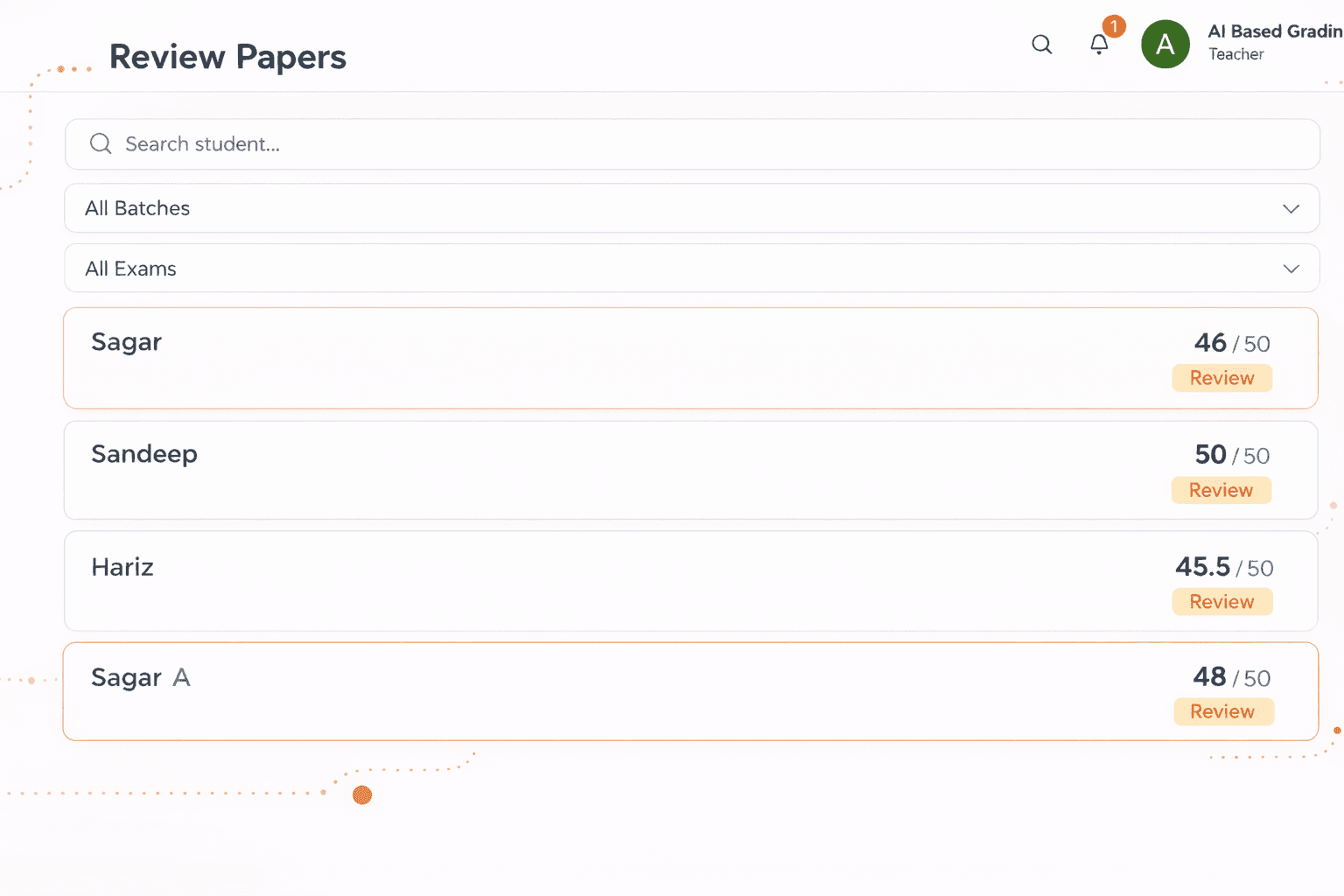
Figure 1: GradeSense grading screen showing human moderator approval and direct override points.
Mitigating **length bias** is another area where AI excels. In subjective humanities and social science exams, studies show human graders unconsciously award higher marks to longer essays, even if they contain redundant or irrelevant information. GradeSense's semantic analysis engine evaluates the actual concepts matching the rubric, ignoring fluff to ensure that students are graded purely on analytical merit.
2. Speed and Turnaround Times
Delayed feedback reduces its educational value. If a student gets their mock test script back weeks after writing it, they have likely moved on to other topics.
Traditional manual grading workflows typically require 8 to 12 minutes per descriptive answer sheet. For an average class size of 60, that equates to 8-12 hours of teacher work per exam. Across large institutes with multiple sections, grading delays of 10 to 14 days are common.
With GradeSense, digitizing and scoring a batch of 500 scripts takes **less than 30 minutes**. AI parses, transcribes, checks against the rubric, and populates scores instantly. Teachers then review and approve the recommendations, reducing the end-to-end evaluation cycle by over 80%.
3. Operational Cost and ROI Analysis
Manual subjective grading comes with hidden operational costs. To illustrate, let us analyze the Return on Investment (ROI) for a coaching center or school network with **1,000 students** running bi-weekly descriptive tests (24 exams per academic year):
Manual Workflow Costs:
- Grading time: 10 minutes per sheet × 1,000 sheets = 10,000 minutes (~166 hours) per exam.
- Annual hours: 166 hours × 24 exams = **3,984 hours** of manual grading annually.
- Labor cost: Assuming an average teacher hourly rate of ₹400, the annual grading payroll expenditure is ₹15.9 Lakhs.
AI Automated Workflow (with GradeSense):
- Grading time (AI + teacher moderation): 2 minutes per sheet × 1,000 sheets = 2,000 minutes (~33 hours) per exam.
- Annual hours: 33 hours × 24 exams = **792 hours** of moderation annually.
- Labor cost: 792 hours × ₹400 = ₹3.1 Lakhs annually.
- Net Annual Savings: **Over ₹12.8 Lakhs saved** alongside **3,192 hours of teacher time** reclaimed for classroom teaching.

Figure 2: The analytical cohort performance screen showing average scores, question difficulty distribution, and overall class heatmaps.
4. Quality of Feedback
A simple circle around a wrong equation or a generic "+2 marks" is not enough to help a student learn. However, under heavy grading workloads, manual corrections are often brief due to time constraints.
GradeSense automatically generates granular, per-question feedback. It highlights the exact step where the logic deviated, mentions missing formulas, and suggests conceptual topics for review. This detailed annotation is automatically appended to the student's digital report, providing a personalized learning path.
Summary Comparison
| Metric | AI Grading (GradeSense) | Manual Grading |
|---|---|---|
| Evaluation Time | Seconds per page | 8-12 minutes per paper |
| Labor Cost | Free (during Pilot) / Low subscription | High hourly cost / Overtime pay |
| Consolidated Analytics | Automated (Instant) | Manual data entry needed |
| Bias Resistance | High (Locked to teacher rubrics) | Medium (Prone to fatigue & halo effects) |
| Feedback Depth | Granular per-question annotations | Brief / Dependent on grader time |
By automating descriptive exam grading, schools and coaching centers optimize their staff resources, letting teachers devote their hours to direct student mentorship rather than data entry and grading paperwork.
AI grading is not designed to replace the classroom teacher. Rather, it serves as a powerful assistant that takes care of the repetitive administrative tasks, allowing teachers to retain final approval and override authority while freeing up their schedules for student interaction.
To explore how automated answer sheet evaluation can optimize grading workflows at your coaching center or school, check out our features overview or book a dedicated live walkthrough.
Written by
Ayush Poojary
Founder, GradeSense